Chapter Nineteen
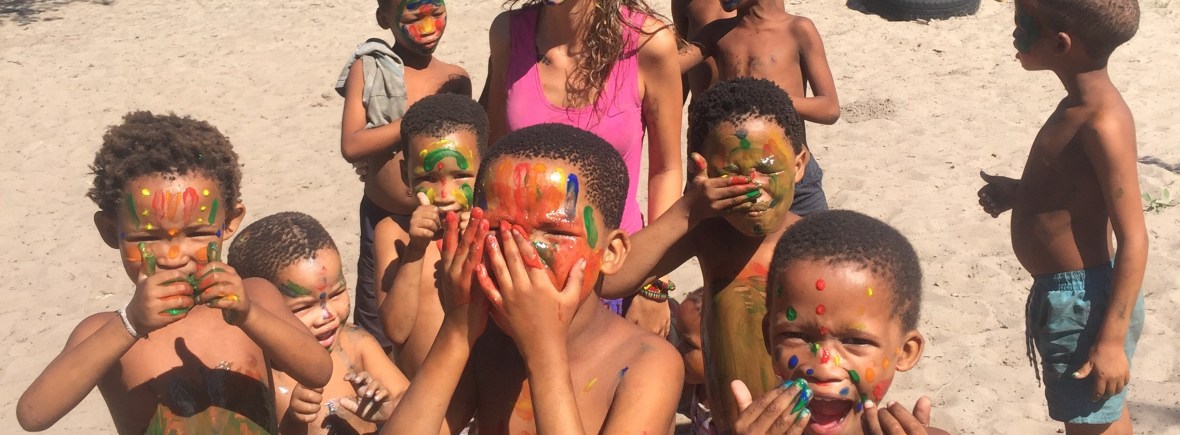
Having the opportunity to teach the San children was a heartwarming experience. The children ranged in ages from three to twelve, though nobody knew their actual age. How amazing would it be to live in a world where time does not define you? I’m not sure if this was for better or for worse but I did attempt to teach the children the concept of time. I played them a song reciting the months of the year and after a few listens they could sing it on their own. Each morning I’d write the month, day and year on the board and after a few days they were starting to understand the pattern. If the next teacher continues this, pretty soon these kids might realize the yearly patterns.
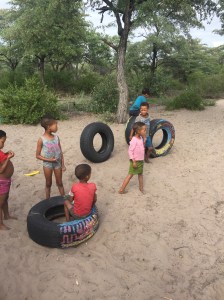
As I already mentioned, the age range was large. The tiny three-year-olds did not have the attention span to sit through a lesson. About an hour and a half into school they would run off and play in the sand, though this was apparently a vast improvement over the mere 15 minute intervals my predecessor was able to hold their attention. Since we were teaching these children outside in the bush, we had only a cloth awning for shade, otherwise the tables and chairs were right out in the sand.
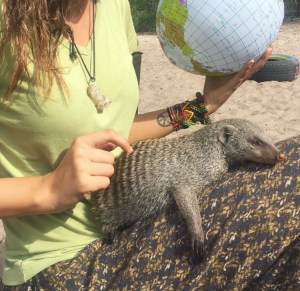
My host rescued an abandoned baby mongoose the year before and nursed him back to health. Crash, as he is called, loves humans and spends most of his time with the San Tribe. The first day when we showed up at the kids’ tents to pick them up, I saw Crash running towards me. In a similar way that you might imagine a squirrel bolting towards you could have rabies, I got quite scared that I was about to be attacked. I ran from Crash, much to the amusement of the San children and their parents. Crash kept chasing me, determined to meet the newcomer. Once I finally let him approach, he put his little arms around my ankle and gave me a hug. Crash would often come along as we would lead the kids to the class/bush area. The very young children were afraid of him and would start to cry when he approached. We often spent a lot of our class time trying to get rid of Crash, but he was very persistent.
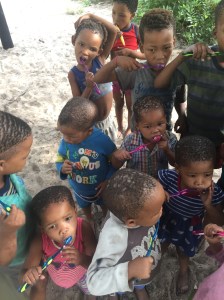
The first thing we did on a typical day was serve the kids an oatmeal breakfast. In fact, this is the only reason some of them would come to class. After that we would give them all their toothbrushes and add some paste. We had a tooth brushing song that the kids would continue singing even later in the day when playing in the bush.
 The difference in skill levels between the children was quite large. Past volunteers’ notes showed that the kids had learned the alphabet a year ago, but really no progress had been made since then. If you were to write the alphabet on the board with a random letter out of order, most of the kids couldn’t identify it. There was however one boy, Ben, who was very clever. I made it my mission to teach him how to read. Another volunteer and I separated the class so that I could take Ben by himself and go over the sounds the letters make. Ben was so embarrassed to be singled out that he cried. It broke my heart to see this amazing little soul so miserable. I didn’t give up though, and by the time I left, Ben could identify many three letter words such as cat, dog and rat.
These children were like sponges when it came to music. You could explain something at the board and it wouldn’t click, but the moment you played a song with a high-pitched voice the kids would repeat it back to you word for word. I’m not sure they understood what they were saying but suddenly they could memorize anything!
The best thing about teaching at this school, opposed to the one in Tanzania, was that we had supplies. There were art supplies, paper, pens, costumes, instruments, and just about anything else we could need. One day I brought the instruments and as some of the kids shook bells and hit drums, the rest of us danced around. I taught one of my students, Andreas, how to shuffle. He picked it up so quickly!
The most difficult part of teaching the kids was the lack of encouragement to learn when they went home. Their parents didn’t speak English and never went to school. Their parents live in harmony with the land and plan to teach their kids to do the same. Why must they go and spend half the afternoon learning Math and English? Like I said, many of the kids only came for the oatmeal. If a kid threw a fit or started a fight you had no way of punishing them. You can’t threaten to tell their parent at a parent teacher conference or to suspend them. They would be all too happy if you sent them back to their tents to play in the sand.

After five weeks with these kids I already noticed some progress, but it was time to go. On my last day I made bubble solution and we had a bubble day. I designed some sticks and string to make large bubbles. The kids cleverly started making bubbles by cupping their hands and with a paper towel roll. I miss these kids a lot, especially Ben. Getting to know them was one of the most rewarding experiences of my life.
Windhoek
My African journey ended in Windhoek. I took a shared car from Grootfontein to Windhoek, which cost 180 Namibian Dollars. My host had encouraged me to take the Intercape bus (250 Namibian Dollars) fearing that the shared car would not be safe. I explained that since I had already taken local transport across Africa, there was no need to stop now. Since the shared car, which picked me up at the Puma Gas Station in Grootfontein, was safe and comfortable, I would recommend it over the Intercape bus if you’re trying to get to Windhoek.
I stayed at a hostel that cost $13 USD per night called Backpackers Unite. While it was the most expensive lodging I paid for in Africa, it did have a delicious free breakfast with tea and coffee.
The hostel offered transport to the airport for 250 Namibian dollars. Considering I paid 180 Namibian dollars to take the 5-hour journey from Grootfontein, this higher price for a 40 minute ride seems ridiculous. However, it was the cheapest option I could find, so make sure you budget for that.
On Independence Avenue in Windhoek there is a craft market that has a lot of cool paintings, bracelets and other arts and crafts.
My departure from Windhoek airport concluded an epic, stressful, fulfilling and enlightening journey across Africa.
The End
(for now)
 Chronicles of a Wandering Soul