
Chapter Six
Attire
Before going to Uganda I was told that people there dress very formally. While in Kenya I saw many girls in shorts cut mid thigh and therefore also wore shorts like that. After Kenya, I never saw an African woman in shorts again. In Uganda the ladies wore long dresses with bright patterns. I actually bought one as well and it was a good thing because it came in handy.
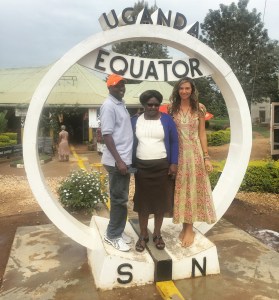
When I first met my hosts for Eco-Agric, Robert and Josephine, I was invited to go with them as they visited Robert’s parents. Josephine runs Eco-Agric and has a PHD. She is a well educated Ugandan female with authority, which is very rare. She is also loud and bossy. She has servants that she yells at to bring her tea or whatever else she may need. When she goes into a store she makes the cashier follow her around and hold her basket as she shops.
However, going to see her in-laws, scared her. She insisted that I wear my long dress. Before we arrived at their house she pulled-over to change out of the dress she was in and into an even grander one with puffs on the shoulders.
Male/Female Hierarchy
I was welcomed in the front door with Robert. His dad was very kind and friendly. Cousins and brothers were also over and we all sat in the front room. Josephine had to walk in through the back door. In fact, I was the only female in the front room. As a guest I was given the privilege of sitting with the men. There were a handful of women in a backroom, cooking for the men. Josephine finally crawled into the front room on her knees. She kneeled in the corner and greeted her father in law, the entire time looking at her hands.
I was shocked, what happened to my loud and bossy host? She later explained that in Ugandan culture the daughter-in-law can never touch or make eye contact with their father-in-law. I asked Robert if he would keep this archaic tradition when their sons got married. They seemed like a modern couple. At home they ate dinner together. To my surprise he said he would keep the tradition. His future daughter-in-law would never eat at the same table as him.
As the food became ready, a woman came in with a plastic bucket and pitcher full of water. She went around to each of us to wash our hands as we stayed seated. The feminist in me hated this unequal treatment. Next, the women brought us food before returning to the back room to eat on the floor. Whenever the guys needed something they would call out and a female would appear with it. It’s typical in Africa for the ladies to work for hours outside over fires cooking as the men sit and wait to be served.
Greetings
One thing unique to Uganda was the hand shake. When a man and a woman shake hands the woman will drop to her knees in a curtsy/bow. If two men are talking on one side of the street and a female is on the other side, she will bow until they pass.
Something that confused me a lot at first but that I eventually got used to was the greeting. Kids are trained with a very generic English greeting. There is no variation and it is always the same whether appropriate or not. Africans learn to say, “How are You?” and “I’m Fine”. The confusing part is when one approaches you and the first thing they say is, “I’m fine.” It left me awkwardly mumbling, “well that’s good.”
Or they would ask how I am and when I would say, “great”, “amazing”, or any other adjective, they would suddenly not know how to respond. Then of course there were the incidents when they would ask, “how are you?” and I’d reply, “marvelous, how are you?” They would automatically say, “I’m fine, how are you?” Confused I’d have to tell them that I am still marvelous.
I’m not judging these interactions. They know way more English than I know of any African language. I just thought it interesting that, “fine” is the word that they all learn in school. It is probably the most boring way one could describe their state of being.
Expressions
Perhaps more confusing was the use of “you’re welcome”. In Western culture we have been trained to say “you’re welcome” after thank you. I’ve got to admit it doesn’t make a lot of sense. If you pass someone the salt and they say thank you, what are you welcoming them to? You are welcome to the salt I already gave you or you are welcome to thank me? In Africa, “you’re welcome” is simple, it means welcome, make yourself at home, enjoy it. However, being familiar with it as a response to thank you, I often mistook this kind welcome for passive aggressive resentment. If somebody brings you dinner and says, “you’re welcome” you immediately feel like an asshole for not having said thank you yet. But really, all they mean is you are welcome to eat this food.
Food and Drinks
 The trademark food of Uganda is Rolex. Throughout Africa you can get Chapati which is basically a fried tortilla. However, in Uganda you add egg, onion and tomato and roll up the chapati and they call it Rolex. It costs about $0.50 and it is delicious!
Sadly quality coffee is hard to come by in Eastern Africa. Even if you order coffee at a cafe, they are going to bring you hot milk and a pack of Nescafe instant coffee. If you only want a splash of milk in your coffee it is best to take it black. It is either completely mixed with hot milk or no milk at all. Tea is quite disgusting as well. Africans automatically add milk and sugar to the thermas that they keep it in. There is no option for black tea.
Breakfast is typically bread and butter. The bread is processed, factory, sugar bread. I couldn’t eat it, it just tasted so artificial. My hosts gave me bread and butter for breakfast. When I had malaria I splurged and booked a hotel with wifi and they also served bread and butter for breakfast. Best to book lodging without an included breakfast and get a rolex on the street.
Laundry
As I mentioned earlier, it is common for well-to-do Africans to hire servants. At my volunteering gig we had a nice lady that did our dishes, laundry and made our food. We soon learned that it’s a big no-no to put any underwear or bras in the dirty clothes. In Uganda only your husband can ever see your underwear. You have to wash your undies with soap as you take a shower.
Babies
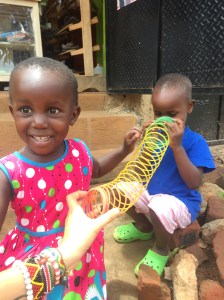
Lastly, and this cultural differences applies for all I saw in Africa, most women have kids. At twenty-five, people were always shocked to find out that I’m not married and I do not have children. It is beautiful seeing women with a kanga strapped around them holding a baby as they balance something on their head. Of course to them it is just their life but I was mesmerized.
Why do most women have babies and so many of them at that? First off, there is a lack of birth control. In the United States free condoms are everywhere. The RA at your college has them, they give them out at music festivals or Planned Parenthood. In some of these remote villages condoms are hard to come by. Even if a store did have them, who would buy them? I worked at a school where kids had to turn in their notebooks everyday before they left or their parents might sell them.

You also have to look at it socially. In Western culture we are blessed with all of these options for our life. Do I want to focus on my career or travel the world? Move to the city or across the country? In some of the tiny villages I went to, they may live three hours from the capital city but have only been there once in their life. They stay put and as everyone around them has kids, socially what else can they do? If they have a lot of brothers and sisters they probably can’t all afford to go to school so there goes their dream of breaking the cycle. No wonder locals looked at me with wonder for traveling Africa on my own. It literally is a foreign concept to them.
 Chronicles of a Wandering Soul