The capital of Nepal was a city I tried to spend as little time in as possible. In general, I try to avoid capital cities, prefering to be out in nature and having a more authentic experience. The capital is where the native Nepalese people flock in order to have career opportunities not available in the villages. As a traveler, it was the quaint experiences of the villages that beckoned me. I came to Nepal to trek and Kathmandu was an unavoidable experience.
Local Bus from the Airport
I flew into the Kathmandu airport which was tiny though conveniently equipped with computers to speed up the visa process. Most people would probably call a taxi from the airport, however, I preferred to walk to the main road past the roundabout and take a local bus to the city. Colorfully painted old school buses with loud horns zoomed down the street. Conductors leaned out the open doors, yelling the locations the buses were headed and I was reminded of Kenya and the frantic local transport system there. The buses had Nepalese script on them and I was at the mercy of the locals to help me find the bus I needed headed towards Ratnapark. Luckily a local boy helped me find the bus and offered me the last available seat, seeing that I was having a hard time balancing myself in the aisle with my heavy bag. I decided to stay in the touristy area of Thamel, which despite sky rocketed tourist prices, had a nice atmosphere.
Thamel
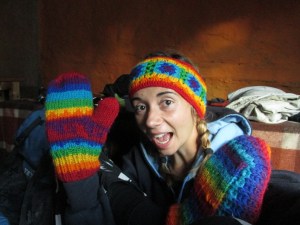 I cannot repeat enough how pointless it is to go shopping in Thamel. When you are trekking, things become more expensive the higher up the mountain you are. Very cold while on my trek, I ended up buying Yak wool socks from the village of Manang at 3,519 meters. The socks only cost 250 Rupees. I was blown away because two weeks earlier I had been quoted 4,000 rupees for the same pair of socks in Thamel.
Thamel is very visually stimulating. Shops line the narrow streets with hippie pants, Buddha and Hindu shrines, prayer flags and with trekking stores and restaurants of every variety. I was reminded of Koh San road in Bangkok by the adventurous backpacker vibe.
Where to Stay
I stayed at The Happily Ever After Hostel which I enjoyed very much. For $5 I got a dorm room and a delicious breakfast with coffee. I later stayed at Shree Tibet for $3.50 but there was no breakfast and the dorm room had one outlet for 7 people to share. For the slightly higher price The Happily Ever After Hostel is by far the superior option. The hostel staff gave me advice on my trek and transportation for the measly price of $1 to buy a map.
Activities
The typical tourist activities while in Kathmandu would include the Monkey Temple, Durbar Square, and Boudhanath. The Monkey Temple was stunning. As I hiked up the long staircase, a sprawling view of Kathmandu emerged. As named, Monkey Temple had many primates picturesquely sitting on the walls. Om Mani Padme Hum played from speakers, prayer wheels lined the stupa and the Buddha eyes looked out upon the city. There are tiny shops lining the stupa where I found a beautiful painting of the AnnaPurna mountain range for as little as $10.


Durbar Square
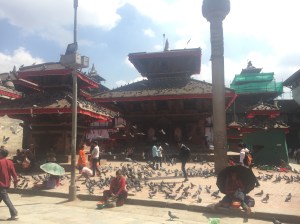 I was shocked when I entered Durbar Square and was told I had to pay 1,000 rupees ($9). As a thrifty traveler I would never spend that much money to see a tourist attraction. My food budget for the day was less than $5 so I nearly left and refused to enter. However, Durbar Square is an iconic and historical area of Nepal and I couldn’t quite force myself to leave. Luckily, you can extend your ticket at an office inside and revisit Durbar Square for free for however long your visa is valid. All you need is a passport and a photo of yourself.
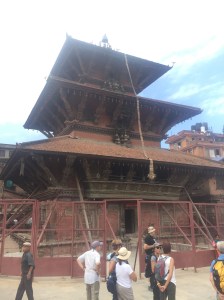 I wandered around the historical city center until an unwanted tour guide attached himself to me. I tried to explain that I had already spent more money than I had planned and I could not possibly take his service. However, the man was relentless and quite adorable and I slowly accepted this new friend. He explained the history of the buildings and showed me a museum that I otherwise would have missed.
Patnem has another Durbar square that is in better condition unlike the Kathmandu square which underwent damage in the 2015 earthquake. Honestly, the adventure just felt like seeing more of the same and my energy level was quickly drained.
The Negative to Kathmandu
The reason I’m less than thrilled about Kathmandu is the dusty inhospitable environment. Locals develop the Kathmandu cough from breathing the pollution and dusty air. Most people wear cloth masks to protect their lungs and I quickly joined the ranks. Besides that, the traffic is hectic and loud. While taking a bus from Pokhara to Kathmandu the bus driver hit a car in the chaotic traffic. All passengers were forced to get out of the bus and figure out their own way from there.
Recommendations
I spent very little time in Kathmandu, using it as a means to get to where I needed to go and nothing else. However, I met a traveler (here is his blog) that spent two weeks solely in Kathmandu, really exploring the deep secrets of the city. Fortunately, he let me in on a few of his favorite spots. The Cafe with No Name is a discrete and cozy spot to enjoy a coffee and relax. A few minutes walk from where I was staying in Thamel there is an enchanted garden called the Garden of Dreams. For a small fee you can enter this sanctuary with high walls blocking the sound of traffic and the dusty air. There is a fountain, grass with matts to lay on, lovely lights at night and a cafe. This place is a sanctuary in such a chaotic city.
In lieu of shopping in the expensive touristy areas, there are local shopping malls hidden in the side streets a few streets on each side of Durbar square. There are also Tibetan refugee camps with high quality decently priced products. There is an organic farmers market every Saturday morning in a hotel car park called Le Sherpa. I also stumbled upon an open air market under a tarp behind Ratnapark. This is a very local place to go shopping.
Kathmandu is a diverse city with many ways it can be experienced. You can fork over American prices and do tourist activities, take taxis and stay at fancy hotels. Or you can stay in dodgy hostels, walk everywhere, find the local spots and eat chow mein or thanga for every meal. Regardless, no trip to Nepal would be complete (or possible) without time in this city.
Living Goddess
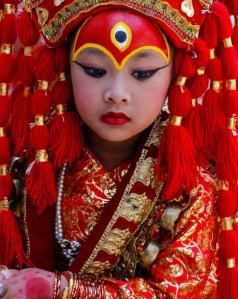 I got to Nepal towards the end of September as a month of Hindu celebration was starting. This celebration included cult like sacrifices of chickens and cows; as well as public drunkenness as they celebrated the god of wine. The creepiest part of this festival was the importance of Kamari the living Goddess. Kamari is a prepubescent girl that is kept in a palace overlooking Durbar square. Once a day she looks out the window and smiles at the locals waiting down below. From the time she is chosen as living goddess to the day the spirit leaves her body (when her period starts) her feet are not allowed to touch on the ground. This young child wears excessive make up and is kept to herself her entire childhood. When she becomes a woman and has her first menstrual cycle she is stripped of her title as they see that as impure. Typically, former living goddesses live a hard life often forced to prostitution for the rest of their days. There is a legend that living goddesses were created by a pedaphilic former king that wanted to keep young girls to himself. Celebrating Kumari and watching the locals cheer as the little girl was paraded through Durbar square on a raised platform was amusing until you discover the dark history of this archaic tradition.
Trekking Prep
Kathmandu is the perfect place to prepare for a trek. You can find many necessary trekking items such as trekking poles for as little as $8. It is necessary to get a trekking permit before you enter any of the mountain ranges. To do this you must go to The Tourist Service Center with the proper amount of money (mine was around $40) and two passport photos. You go through a few different lines and fill out paperwork and in a few hours you will legally be able to hike in Nepal. To do the Annapurna trail I had to take a micro bus from Kathmandu to Besisahar (180 kilometers and 7 hours) which is the last city before the trail starts. There is a permit checkpoint there and an option to rent a Jeep to take you farther up the trail. To read more about my hiking adventures read my other article.
Nepalese Kindness
In all of my travels never have I experienced the kindness that I received in Nepal. I always find heart warming individuals wherever I travel but there are always a few creeps that make me flee a situation. However, in Nepal I had nothing but positive experiences. The shop owners in Thamel were not pushy or aggressive like in most touristy places. The rescue team on my trek while hiking the AnnaPurna circuit was kind and not concerned with charging me for my late night doctors visit. While in Kathmandu many locals gave me advice for free on how to organize my trek. Even though I chose not to have a porter, everybody wanted to help me. Despite disliking the dry and drustiness of Kathmandu and the cold weather of the extreme altitudes, Nepal and its people have grabbed a special place in my heart and I will always look back fondly on my time there.
 Chronicles of a Wandering Soul