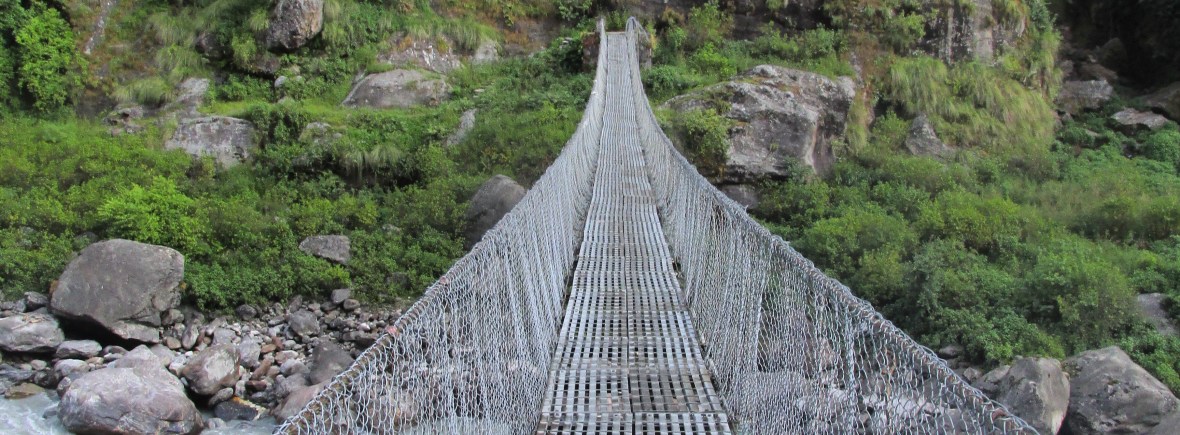
Nepal is well known for its trekking, as it contains 8 of the world’s 10 tallest mountains. During the peak trekking season, it can actually get quite crowded. The mountains are stunning, but it isn’t the hidden gem that I found Georgia to be.
The Annapurna Circuit
 Despite being “mainstream,” I quite enjoyed familiarizing myself with the 20 or so faces that were on the same timeline as I was while trekking the Annapurna Circuit. As one pair of trekkers (plus their porter) would take a break, I would pass them with a friendly, “Hello!” Soon enough I would be taking a break and it would be their turn to pass me. One group might have a later start and I wouldn’t see them for the entire day; then, suddenly, I’d run into them at my guest house that evening. As each day passed the familiar faces became friends and it became clear that we were all rooting for one another.
 The Nepal trekking community was welcoming and respectful of each individual’s journey. I would expect no less from like-minded, well-traveled, athletic, nature-loving, thrill seekers. “Touristy” or not, I thought the crowd had a great vibe and I didn’t mind seeing other people on the mountains. I did, however, start trekking at the end of September. The monsoon rains ended early, which meant the weather was perfect and I was a week ahead of the presumably larger crowds.
Should I hire a Porter?
I decided to do my trek without a guide or porter. I know other people that have done it that way and had been reassured that it was safe. As there are no ATMs on the trail, you actually have to carry all of your money on you. I hadn’t heard about criminals hiding behind rocks and robbing tourists; in fact, I never felt threatened. Having said that, I made use of other people’s guides and made sure to ask them any questions I had. Rather than reserve their knowledge for paying customers, they freely gave advice wanting the best for me as well.
Free Advice
 In Kathmandu I stopped into a tourist agency to ask about the bus to Besisahar and the man behind the counter ended up writing down a complete day-by-day hiking schedule and giving me a map, free of charge. He gave me amazing tips, like that I should face down the mountain while catching my breath because oxygen rises. Or that on the day of hiking to Thorung La I’d need to wake up at 4:00 a.m. and start hiking with my head lamp in order to avoid the mid-afternoon winds. Also, he told me I should hike very slowly on Thorung La day because if my body produced sweat it would freeze.
Me vs My Body
Frequently while trekking I would compare the experience to a multi-day, solo trek I had done three months earlier in Georgia. The Georgia trek ended up being Me vs. Nature. I was battling rain and hail as I struggled to find the trail markers, which were obscured by snow. Trekking in Nepal turned out to be Me vs. My Body. Either from the dust of Kathmandu or going from warm India to the cold Himalayan mountains, I quickly developed a cold. My runny nose meant that I had to breathe through my mouth. The cold air in turn gave me a sore throat, and I developed a slight cough. I tried to go to a “pharmacy” in a small village along the trail and could only find vitamin C tablets and ginger throat lozenges that didn’t seem to work. The ibuprofen I had brought with me did dull the throat pain though. My advice is to bring cold medicine with you even if you feel completely healthy before you start the trek!
 Despite the challenges my body was facing, the trekking itself did not impose a threat. I’d wake up very cold at 6:00 a.m. but somehow managed to avoid putting on anything more than a shirt and shorts, knowing that soon I would be sweating. Adrenaline pumping, I’d walk at a brisk pace, too pumped-up to take many breaks. However, when I’d reach my guest house (at a higher altitude) at the end of the day my body would go into shock. I’d be sweat drenched, not moving, and in the immediate cold that hits once the sun sets. I’d bundle up in all my warm clothes and start pounding down glasses of ginger tea. I seemed sickly until the next morning when I’d wake up and go at the trail like a maniac once again. It was a weird routine that had me constantly oscillating between being slightly ill and pumped up on adrenaline.
Altitude Sickness
 The last battle I had with my body was due to the altitude. Before beginning my trek I got 250 mg Diamox tablets at a pharmacy in India. I took half a pill in the morning and half at night to avoid any altitude sickness. Having recently read Into Thin Air I was quite terrified about getting Acute Mountain Sickness (AMS), High Altitude Cerebral Edema (HACE), or High Altitude Pulmonary Edema (HAPE). I’d previously never gone above 9,000 ft. so I truly didn’t know if my body could handle it. It didn’t help that there were signs everywhere on the Annapurna Circuit warning of the dangers of altitude sickness. Technically that is helpful, but I was already so worried that it made me paranoid. A poster along the trail read, “Any sickness at high altitudes is altitude sickness until proven otherwise.” With my recently developed cold I was wondering if it was perhaps more than a quick climate change and swallowing dust that was causing me to get sick.
While stretching outside one afternoon I saw a helicopter fly overhead and some nearby trekkers commented, “their insurance is fucked.” The helicopter was an emergency rescue for somebody with potentially fatal altitude sickness. It was a humbling moment and it made me realize it can happen to anyone. We are all on the same day-by-day plan. However, some people’s bodies can handle it and some need more time to acclimate. I hear the biggest issues happen in larger groups where people push themselves too hard to keep up with their friends or tour group.
Altitude sickness is no joke and I did eventually have to battle it. I arrived in Manang at 3540 m after a long day of trekking. I had started my day in Upper Pisang at 3200 m and reached an elevation of 3660 m while trekking through Ngawal during the day. They say trek high, sleep low since your breath is shallow while sleeping and you receive less oxygen. Since I trekked through Ngawal and then descended to Manang I thought I’d be fine. Probably because of the medication I was taking for altitude sickness, I felt completely fine throughout the day; I had no headache, had a healthy appetite, and my cold even seemed to be getting better.
They say that altitude sickness takes 2 to 8 hours to kick in. I arrived at the town at 4:00 p.m. and went to bed after dinner around 7:00 p.m. I woke up at 8:00 p.m. noticing that it was hard to breathe. I took some deep breaths and slowly drifted back to sleep. At 10:00 p.m. I woke up gasping for air. Something was wrong. I turned on my light switch and the room was distorted and moving. Everything was maroon and green. I was disoriented and scared. My worst nightmare was coming true; I had altitude sickness. Any moment now I could start puking, pass out, and have to be picked up by a helicopter. Going from sound asleep to not being able to see straight or breathe, I immediately assumed the worst. However, slowly slowly, things actually got better.
I called my mom and she later recounted that I sounded disoriented and my words were unusually spaced apart. She instructed me to wake up the owner of the guest house. I tried, but I was locked outside. The family lived inside and out the back there was a ladder leading to guest rooms on the roof. The door into the main house was locked and as the only guest, I had nobody to turn to. After many minutes of pounding on the door the owner answered. I told her I might have altitude sickness but I didn’t know for sure, I just needed help. All the posters say to never leave somebody with altitude sickness alone so I expected her to care. However, she told me to go back to sleep.
Instead, I roamed the streets hoping I could ask a porter for advice. It was only slightly after 10:00 p.m. During this time I was disoriented, lights had tracers, and focusing was hard. Sadly, nobody was around and I ended up outside of the closed Manang medical clinic. A sign said, “Open 24 hours for emergency” and that an after-hours visit would be $80. Knowing that it would be a hell of a lot cheaper than an emergency helicopter I started knocking on the guest house doors inside the clinic, but nobody answered. This clinic gives daily lectures on altitude sickness awareness, yet if somebody actually gets altitude sickness there is nobody to help. Considering that it takes 2 to 8 hours for it to set in, most people would experience it at night. I had a Nepalese SIM but there was no number to call to receive this supposed emergency service.
I walked back to my guest house which had WiFi and called my mother. She ended up calling the Nepalese tourist police which transferred her to the police in Manang. They said they would come to my guest house with oxygen. It took five hours for them to arrive. At 3:00 a.m. I felt completely fine because I had been breathing deeply for 5 hours. The police took my oxygen level and confirmed that it was fine. I explained my experience while sleeping and they said it was normal to gasp for air and hallucinate at high altitudes. They told me to stay in Manang for three days to acclimatize but after that I’d be fine to go up. I went back to sleep at 5:00 a.m. and in the three hours I managed to sleep I woke up three times gasping for air.
The guys that helped me at 3:00 a.m. were amazing. They didn’t even charge me for the emergency service, which was shocking. However, the experience rattled me to the core. Had I actually been in danger, puking or with brain swelling, I could have died in the five hours it took the help to arrive.
During the trek I had never wished I had paid for a porter or guide, until then. My porter would have taken me to his friend who could have helped, or at least lead me down the mountain in the dark. Traveling alone and staying at the cheapest guest houses meant that I was completely alone in a time of potential danger. For this reason alone I’d urge others to consider trekking with a porter, a close friend or to look into who you can go to in the middle of the night if you wake up very sick.
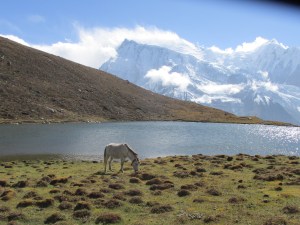 The score evened out in the battle between myself and my body. The next day I hiked to Ice Lake at 4600 m. I still spent the night in Manang but after experiencing even less oxygen at the lake, my body appreciated the air in Manang. That night I slept without gasping for air.
Later during the trek I was lying in a dark room, not yet asleep, when I noticed hundreds of twinkling lights along the walls and ceiling. As I stared at the lights they started to dance and move. I turned on the ceiling light and noticed the walls were moving. I took some deep breaths and ignored it. The doctors told me hallucinating at high altitudes was normal!
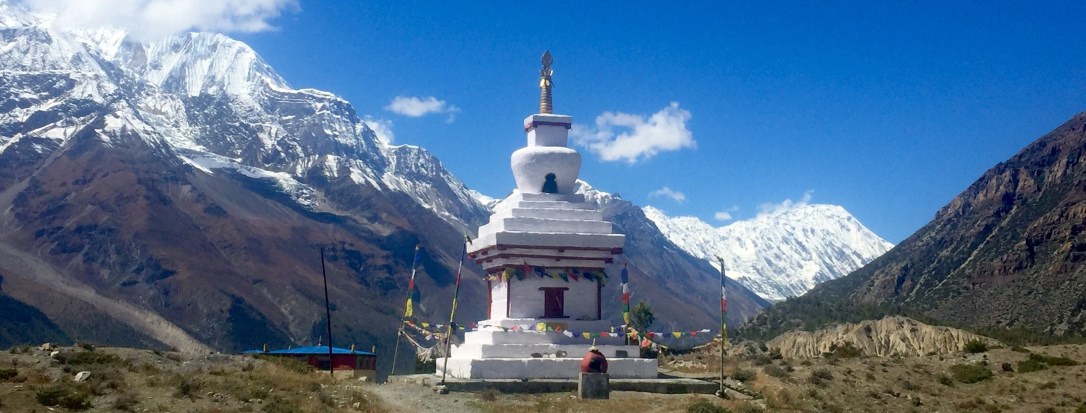
Tips for trekking the Annapurna circuit
- Everything is more expensive on the mountain. The higher you go the more expensive things get.
- I was often able to have my room for free by agreeing to have dinner and breakfast at the guest house. Who has ever heard of such a thing? Free board for meals you will need to eat anyways!?
- If you order Dal Bhat they will refill your plate. If you are really hungry this is the meal to get!
- There are roads running from Besisahar to Manang and from Muktinath to Pokhara. Technically, you can hire a jeep to take you part of the way if you don’t want to walk all the way to Manang. However, you’ll then risk not giving your body proper time to acclimate. As a trekker, the trail is sometimes on the road but often there is a trekkers path, which is more difficult. I often gained 1,000 ft. in altitude just to lose it again, while the jeep road seemed to steadily go up.
- Get trekking poles! I’d never used them before, but they were very helpful. I’ve always felt uneasy on downhill dusty paths, but if you plant your trekking pole you can secure yourself even if you start to slide.
- Bring water purification tablets. There are lots of spigots to fill your water along the way.
- Chame has a hot spring. I didn’t bring any sort of swimming attire or suitable undergarment, but my feet sure enjoyed the warm water!
- I’d heard of the Nepal tea house treks long ago. Then I started trekking and was shocked to find myself staying in self-labeled guest houses. Sure, they had tea you could order by the cup, or in a kettle, but who started calling them tea houses? Then one day on my hike from Upper Pisang, right before Ghyaru I stumbled upon a little hut selling tea. This hut was strategically placed on a steep ascent where anyone would welcome a chance to sit down and rest. Again, on the way to the Ice Lake and even by Thorung La there were little houses selling tea.
- Trekking in Nepal and my safari in Zambia have been the main splurges of my travels. It is cheap if you are a working Westerner taking a month-long holiday. It is outrageously expensive if you are an unemployed traveler that typically volunteers and stays places for free. Permits and a TIM card into Annapurna cost around $40. Even though you don’t pay for lodging you’re likely to pay $5 for both dinner and lunch and $4 for breakfast. Then if you want tea that is $1-3 more dollars a day. I budgeted $15 a day and that was an extremely low budget. It meant not indulging in the cappuccinos and chocolate pastries in Manang.
- Boy was I surprised that all the guest houses had WiFi and electrical outlets (though not always in my room). You will not be off the grid. Well, that is assuming you make it to a village each night.
- Trek high, sleep low. The night before Thorung La I would encourage you to sleep in Thorung Phedi instead of the High Camp. Reach Thorung Phedi before lunch, then in the afternoon you can hike to the High Camp and back to acclimatize. The High Camp is roughly 300 m above Phedi and in my opinion is a dangerous place to sleep without supplemental oxygen. That makes your trek the next day longer but overall safer for your health unless you are a high altitude beast.
- It gets very cold once the sun sets. Heaters aren’t a thing and rarely did a guesthouse light a fire. I was in bed under two covers and my sleeping bag by 7:00 p.m. each night.
- The trail is very dusty. As jeeps ride by carrying tourists and supplies they turn up clouds of dust. A face mask is very helpful.
Trekking the Annapurna Circuit was like entering another world. I was surrounded by fellow trekkers, beautiful nature and constantly challenging myself physically. There is nothing else like it and I can’t recommend this experience highly enough.
 Chronicles of a Wandering Soul